
Surviving North Carolina Pollen Season: Filters, Purifiers, and Humidity Control
The Anatomy of Eastern NC Pollen Season: Loblolly Pine, Oak & Ragweed
Anyone who has spent a spring in Dunn, Erwin, Benson, or Smithfield recognizes the thick yellow blanket that settles over cars, front porches, and roofs between late March and early May. Eastern North Carolina's extensive loblolly pine forests release millions of tons of pollen into the warm spring breeze, creating unprecedented challenges for residential indoor air quality.
While individual pine pollen grains measure 50 to 100 microns in diameter—large enough to be seen with the naked eye—turbulent spring winds and drying sunshine break these grains into microscopic fragments. These sub-10-micron particles easily bypass nasal airways, lodging deep inside bronchial passages and triggering severe allergic rhinitis, coughing, and asthmatic inflammation.
- Pollen Infiltration Pathways: Leaky return ductwork in vented crawlspaces or hot unconditioned attics pulls pollen and roadway dust straight into the HVAC airstream through unsealed seams and joints.
- Home Depressurization: Exhaust fans in bathrooms and kitchens exhaust indoor air, creating negative pressure that pulls unfiltered, pollen-saturated outdoor air through window gaps and recessed lighting fixtures.
- Extended Allergy Timeline: The spring yellow pine pollen wave is immediately followed by oak, sweetgum, and hickory tree pollen, leading directly into summer grass pollens and autumn ragweed.
Air Filtration Rating Guide: MERV 1 to 16 Comparison
HVAC filters are tested and certified according to the ASHRAE 52.2 standard, which assigns a Minimum Efficiency Reporting Value (MERV) from 1 to 16 based on how effectively the media traps particles across three size ranges:
| Filter Category & MERV Rating | Particle Capture Capability (0.3–10 Microns) | Airflow Resistance / Static Pressure Drop | Recommended Replacement Interval | Pollen & Allergy Protection Level |
|---|---|---|---|---|
| Spun Fiberglass (MERV 1–4) | Less than 20% of particles >10 microns; 0% fine dust | Extremely low (0.05–0.10 in. w.g.) | 30 Days | None (protects furnace equipment only, not human lungs) |
| Basic Pleated (MERV 6–8) | Traps 70% of pollen and mold spores (3–10 microns) | Moderate (0.15–0.22 in. w.g.) | 60–90 Days | Moderate protection against visible pollen and household dust |
| High-Efficiency Pleated (MERV 11) | Traps >85% of pollen, pet dander, and mold spores (1–3 microns) | Moderate-High (0.22–0.30 in. w.g.) | 60–90 Days | High protection; ideal for standard residential allergy sufferers |
| Deep-Pleated Media Cabinet (MERV 13) | Traps >90% of bacteria, pollen, and smog (0.3–1 microns) | Low-Moderate in 4"–5" depth (0.15–0.25 in. w.g.) | 6–12 Months | Superior protection; hospital-grade allergen capture without choking blowers |
| True HEPA Filtration (MERV 17+) | Traps 99.97% of particles down to 0.3 microns | Severe (0.80+ in. w.g.; requires dedicated bypass blower) | 12–24 Months | Maximum medical-grade clean room sterilization |
Why 4-Inch and 5-Inch Media Cabinets Outperform Standard 1-Inch Filters
Many homeowners attempt to solve allergy flare-ups by purchasing dense 1-inch MERV 13 filters from retail home centers. Unfortunately, cramming a high-efficiency media into a 1-inch frame creates severe airflow resistance that chokes the blower motor, spikes energy consumption, and causes evaporator coils to freeze up in cooling mode.
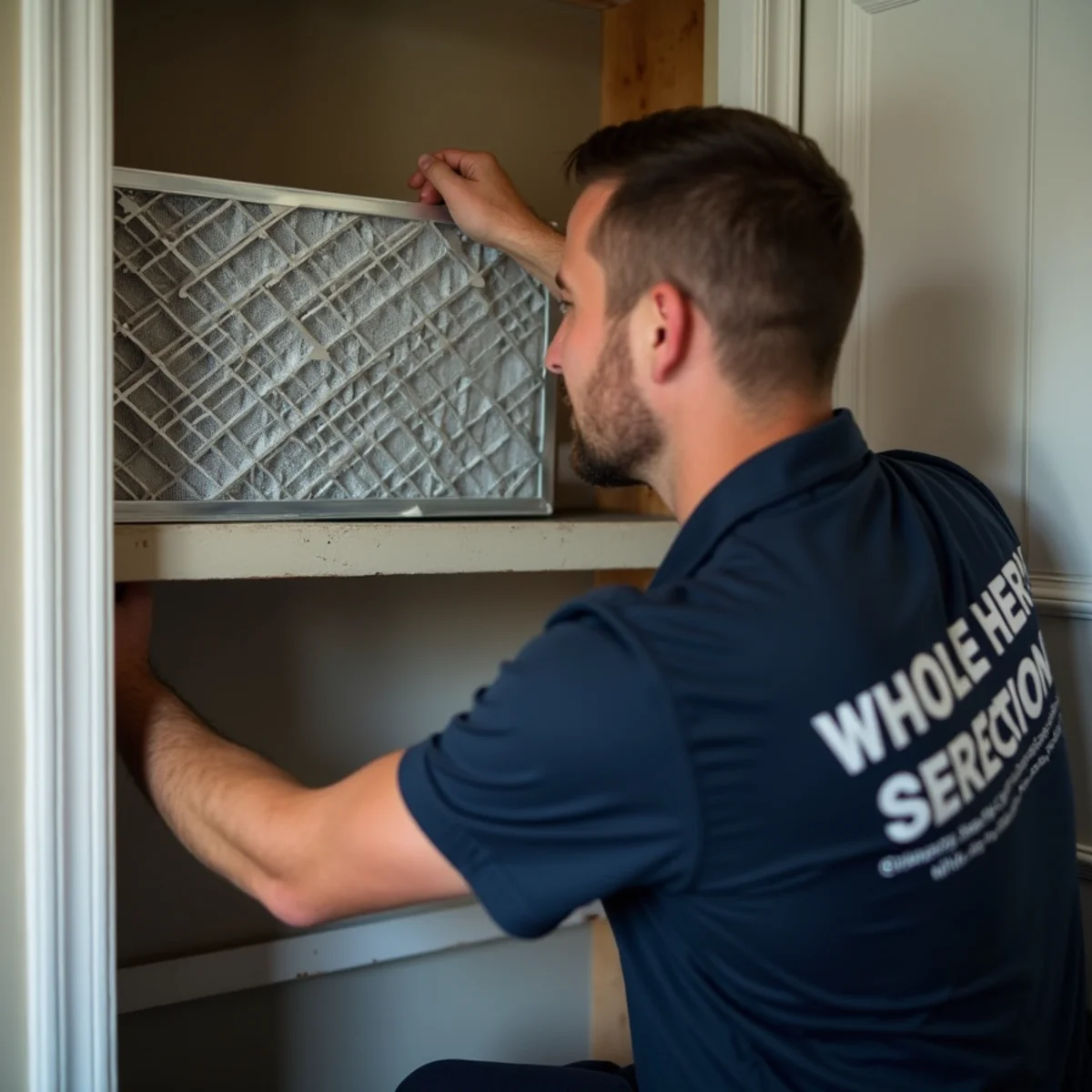
The professional solution is installing a whole-home 4-inch or 5-inch media air cleaner cabinet (such as an Aprilaire or Honeywell Home media system) directly adjacent to the indoor air handler or furnace. Because 4-inch media filters feature deep accordion pleats, they provide 30 to 40 square feet of filtration surface area compared to just 4 square feet on a standard 1-inch filter.
This vast surface area allows air to pass through at a relaxed face velocity, capturing microscopic pollen grains and smoke particles with exceptional efficiency while maintaining a remarkably low static pressure drop. Furthermore, 4-inch media filters only need replacement once or twice per year, saving homeowners time and hassle.
Field Diagnostic: Airflow Resistance & Static Pressure Hazards
During in-home air quality audits across Harnett and Johnston counties, our technicians frequently discover residential systems struggling with high static pressure caused by dense 1-inch filters. A typical residential ECM blower is designed for a total external static pressure of 0.50 in. w.g. across the entire system. A dirty 1-inch MERV 13 filter can create a pressure drop of 0.35 in. w.g. on its own, leaving almost no room for ductwork and evaporator coil resistance. The restricted airflow starves the indoor coil, leading to frozen refrigerant lines, overheated blower electronics, and premature motor failure. Upgrading to a 4-inch media cabinet provides superior MERV 13 filtration with less than half the airflow resistance.
Need an HVAC Specialist in Dunn, NC?
Controlling Indoor Relative Humidity to Stop Dust Mites and Mold
Pollen is only one component of Eastern North Carolina's seasonal allergy puzzle. Spring and early summer bring prolonged rainfall and outdoor relative humidity levels exceeding 75%. When outdoor air infiltrates living quarters, indoor humidity quickly climbs above 55%.
High indoor relative humidity creates ideal conditions for microscopic dust mites to multiply inside mattresses, upholstery, and carpets. Simultaneously, moist indoor evaporator coils and uninsulated duct boots in crawlspaces develop thriving colonies of Aspergillus and Cladosporium mold.
To maintain pristine indoor air, cooling systems should be paired with dedicated whole-home dehumidifiers or crawl space encapsulation systems. Maintaining indoor relative humidity between 45% and 50% dehydrates dust mite populations, halts mold spore germination, and allows homeowners to feel comfortable at warmer thermostat setpoints, saving energy.
Active Air Purification: Germicidal UV-C Lamps & Bipolar Ionization
While mechanical filters capture airborne particles that pass through the return grille, active air purifiers neutralize pathogens, organic vapors, and microbial growth inside the HVAC equipment itself:
Germicidal UV-C Coil Lamps: Installed directly over the indoor evaporator coil and drain pan, commercial-grade UV-C lamps emit continuous 254-nanometer ultraviolet light. This lethal light wavelength penetrates the cellular DNA of mold spores, bacteria, and viruses, preventing the formation of biological slime on coil fins and eliminating the notorious 'dirty sock syndrome' odor.
Needlepoint Bipolar Ionization (NPBI): Advanced purification systems (such as GPS or Phenomenal Aire) generate millions of positive and negative oxygen ions that travel through ductwork into every room. These ions bond with microscopic pollen grains, smoke particles, and pet dander, agglomerating them into larger clusters that are easily trapped by return filters while neutralizing odor-causing volatile organic compounds (VOCs).
Related Services & Service Areas
Related HVAC Services
Nearby Communities Served
Frequently Asked Questions
Common inquiries related to this guide.
Yes. Installing a dense 1-inch MERV 13 or HEPA filter in a system with undersized ductwork can choke airflow, causing total external static pressure to exceed safe equipment limits. Restricting airflow causes evaporator coils to freeze into solid ice during cooling mode, overheats blower motors, and can crack heat exchangers in winter. Always verify static pressure before jumping to higher MERV ratings on 1-inch filters.
Not urgent? Send a request
Planning a replacement or seasonal tune-up? Fill out the form below. For the fastest help, call (321) 478-0693.